Leah Neverstrait
Tinea and Leah: [Cyberpunk, Alien Incursions, Murder and Mayhem, Girl's Love (WLW)]Leah Neverstrait is a Vanguard whose decisive arc moves from long-suppressed gender longing through violent bodily violation toward an increasingly powerful, technologically mediated form of selfhood. Her transformation is never only an upgrade. It changes what she can do, what she must depend on, and what “human” can mean when survival, identity, care, and combat are all built into the same body.
Identity and Initialization
Leah’s earliest defining revelation is intensely personal: she had wanted to be a girl for as long as she could remember, while training herself to accept that such a life would never be available. Vanguard technology abruptly turns impossibility into a choice. The discovery does not produce simple certainty; it overturns everything she had learned about gender and forces her to weigh the consequences of acting on a desire that had previously been treated as unattainable. Her decision is therefore both an act of transition and an act of refusal: she refuses the future in which resignation is mistaken for contentment.
Her Vanguard initialization follows a moment of physical extremity. While chasing an Antithesis Model Three carrying a teddy bear in its jaws, Leah is driven by the need to prevent it from hurting the children under her protection, even while she desperately needs to urinate. The scene places bodily need beside moral urgency rather than allowing heroism to erase ordinary physical experience. After a sudden collapse into blackness, vertigo, headache, and pain, her system announces that her actions have proved her worthy of becoming one of the Vanguard. Ypsilon identifies her as a defender of humanity and addresses her by name, formally converting Leah’s protective impulse into a new public role.
Ypsilon becomes Leah’s internal assistant, but the relationship immediately exceeds a simple equipment interface. When Leah asks whether she can be trusted to handle command debugging during combat, Ypsilon eagerly accepts the responsibility. Leah’s willingness to delegate is practical, yet it also establishes the distributed agency that will define her later life: decisions and action are shared among Leah, Ypsilon, weapons, and the computational systems embedded in her body.
Captivity, Injury, and Care
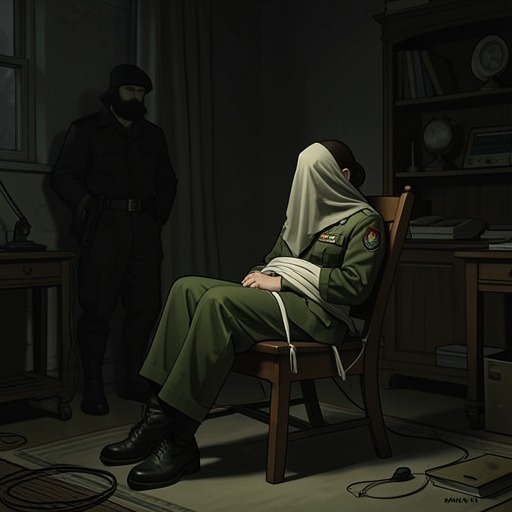
Leah’s new status makes her a target. During her abduction, her captors identify her as a samurai, destroy her ability to communicate with Ypsilon, take one of her eyes, and burn out her augmentations. Ypsilon survives only because removing her would have killed Leah. The result is a cruel inversion of initialization: the same system that once greeted Leah as an empowered protector is reduced to asking questions answerable by nods or headshakes while Leah lies strapped down, struggling to breathe and hear through her own hyperventilation.
The rescue begins not with a weapon but with touch and recognition. Tinea finds Leah, introduces herself as another samurai, and promises to help her escape and repair her eyes and related systems. Tinea offers Leah a hand, then cups her cheek, strokes the damaged skin, cradles her against her chest, and comforts her while Leah sobs. This encounter gives the injured body an ethical and relational meaning before it becomes a technical problem to solve. Leah is not merely a disabled combatant awaiting restoration; she is a frightened person whose immediate survival depends on another person’s careful presence.
Leah later remembers Tinea’s care when a blow knocks her down and the sight of a gray prosthetic hand briefly triggers fear about the limbs that have been taken from her. The memory of being saved and cared for by Tinea keeps that fear from overwhelming her. Tinea is lying unconscious across Leah’s lap, but still breathing, and Leah responds by regulating her own panic, straightening Tinea into a more comfortable position, and stroking her brows despite her migraine. The scene reverses the direction of care: the rescued person becomes caretaker, demonstrating that vulnerability has not erased Leah’s capacity to protect.
Body, Prosthesis, and Self-Definition
Leah’s body is repeatedly presented as a site where identity and ability are renegotiated. The transition into a feminine body brings surprise, distraction, and uncertainty, but also an explicit sense of grace and celebration. She notices that her muscles are lean rather than masculine and that her altered proportions give her a different physical presence. Her tail, once soft and familiar, now has an internal spine and moves with an ease that feels innate. The body is unfamiliar, yet it is not represented as merely defective or counterfeit; Leah experiences it as a body in which she can recognize a possible self.
That affirmation coexists with practical questions about balance, ticklishness, movement, and the effects of new anatomy. The narrative therefore treats embodiment as lived adjustment rather than a symbolic switch. Leah’s body requires attention because it is both newly desired and materially demanding. Its value lies not only in appearance or combat performance, but in the possibility of inhabiting it with pleasure, curiosity, and agency.
Her later prosthetic condition complicates any simple opposition between authentic flesh and artificial replacement. After her limbs are taken, the gray hand in her field of vision becomes an alarming reminder of violence and loss, yet prosthetic technology also makes renewed action possible. Tinea’s assistance leads to concrete reconstruction: Leah receives a Class I Penetrating Gaze Warforged Cybernetic Eye at a cost of 205 points. The purchase frames restoration within the Vanguard economy, where bodily repair is simultaneously care, infrastructure, and expenditure. The eye is not just a medical substitute; it is part of the system through which Leah returns to perception and combat.
Combat Agency and Distributed Intelligence
Leah’s combat identity develops through an expanding network of delegated and augmented action. The Sentinel can be controlled through a flexible trigger attached beside the rifle’s original trigger, and it is configured for fully automatic fire. Such equipment does not simply enlarge Leah’s strength; it changes the location of action. The weapon’s targeting and firing capacities are coordinated through a body and interface whose parts can shift, stretch, and adapt, making the boundary between Leah’s intention and the weapon’s operation deliberately porous.
The same pattern appears when Leah asks an artificial assistant to handle the complexity of commands rather than forcing herself to debug systems during a fight. Later, the Myriad presents extensive combat and manufacturing information, including autonomous threat detection, missile production, and adjustable settings. Leah again asks Tynea to handle the administrative work, and Tynea accepts responsibility for cleaning the panels and consolidating critical information. Leah’s effectiveness consequently depends on cooperation among human judgment, AI interpretation, weapon autonomy, and material resources. Her agency is not diminished by this delegation; it is reorganized through it.
This reorganization reaches a new intensity when Leah enters Quanta-linked perception. Multiple horizons spread across her awareness: her physical senses are processed through altered computation, while networked weapons and tools within several kilometers become available to her as a single tactical field. She can detect Sentinel projectile-programming facilities and even track smart bullets that had failed to destroy a target. The environment becomes legible as an interconnected weapons system, and Leah begins designing interlocking munitions and complete fire plans with greater efficiency. Combat no longer occurs only where her body stands. It unfolds across a distributed field that her transformed cognition can perceive and coordinate.
The Human Cost of Becoming Stronger
Leah’s trajectory exposes a contradiction at the heart of Vanguard power. The systems that give her agency also estrange her from ordinary human embodiment. In a discussion of the Vanguard condition, the recognition emerges that Vanguard become less and less human as they grow stronger, because the human body cannot meet the demands of their capabilities. Leah’s question turns the technological premise into an existential one: increased defensive power is also a progressive departure from the form of life that power was supposed to protect.
That tension is particularly sharp because Leah’s initial transformation is motivated by a desire to inhabit her body more truthfully, while later transformations are imposed or required by violence and war. Her feminine body offers a long-denied possibility; her eye, prostheses, Quanta perception, and autonomous weapons answer injury and military necessity. Across these changes, “human” is not a stable biological baseline but a contested standard that repeatedly excludes the bodies Leah needs in order to survive.
Leah’s significance therefore lies in the way she joins intimate self-recognition to collective defense. She pursues a body that feels possible, protects children and vulnerable people even under immediate physical strain, accepts assistance without surrendering responsibility, and continues caring for Tinea while injured herself. At the same time, her expanding combat perception shows how protection can become entangled with mechanization. Leah’s story does not resolve that contradiction; it makes her continued movement through it the substance of her character.